Design Pattern
Behavioral Patterns
Behavioral Design Patterns
Behavioral patterns in software design focus on effective communication and the assignment of responsibilities among objects.
Behavioral Patterns {style=“font-size: 40%;”}
| Pattern | Description | Covered |
|---|---|---|
| Observer | Defines a one-to-many dependency between objects so that when one object changes state, all its dependents are notified and updated automatically. | ✅ |
| Strategy | Defines a family of algorithms, encapsulates each one, and makes them interchangeable. Strategy lets the algorithm vary independently from clients that use it. | ✅ |
| Command | Encapsulates a request as an object, thereby allowing for parameterization of clients with queues, requests, and operations. | ❌ |
| State | Allows an object to alter its behavior when its internal state changes. The object will appear to change its class. | ❌ |
| Chain of Responsibility | Passes the request along the chain of handlers. Upon receiving a request, each handler decides either to process the request or to pass it to the next handler in the chain. | ❌ |
| Interpreter | Provides a way to evaluate language grammar or expressions. The Interpreter pattern defines a grammar for the language, as well as an interpreter that uses the grammar to interpret sentences in the language. | ❌ |
| Memento | Captures and externalizes an object’s internal state so the object can be restored to this state later. | ❌ |
| Visitor | Represents an operation to be performed on the elements of an object structure. Visitor lets you define a new operation without changing the classes of the elements on which it operates. | ❌ |
| Template Method | Defines the skeleton of an algorithm in the method, deferring some steps to subclasses. Template Method lets subclasses redefine certain steps of an algorithm without changing its structure. | ❌ |
Strategy Pattern
Strategy Pattern
Composition over inheritance!
Strategy Pattern is defined as:
- Defining a family of algorithms
- Encapsulating each algorithm
- Making them interchangeable
Inheritance vs. Composition
- Inheritance is not always intended for code reuse.
- Composition offers greater flexibility in many scenarios.
- Strategy Pattern focuses on using composition over inheritance.
Problem Statement: Duck Example
- Consider a system with different types of ducks.
- Each duck type has its own display method.
- Common methods like
quackare shared.
public class Duck {
    public void quack() {
        // Common quack behavior
    }
    public abstract void display();
}
Problem Statement: Duck Example
- We have different types of ducks: wild duck, city duck, rubber duck, lets add them one by one
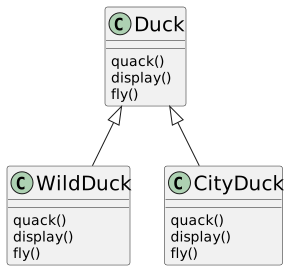
Problem Statement: Duck Example
- I want a rubber duck 🐥
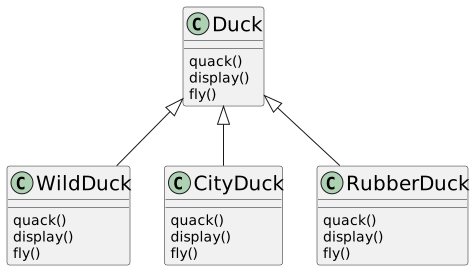
Can RubberDucks fly?
Problem Statement: Duck Example
- We found two new types of ducks: MountainDuck and CloudDuck, they fly at supersonic speed 1 in a ZigZag pattern.
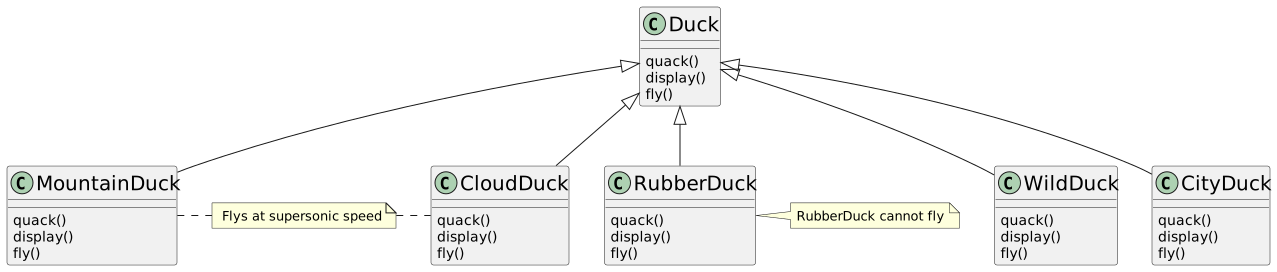
Problem Statement: Duck Example
- Now the Ducks want food, WildDuck and CityDuck eat rice but MountainDuck and CloudDuck eat only quinoa whereas RubberDuck eats ?

Introducing the Strategy Pattern
- The Strategy Pattern allows the duck’s behaviors to vary independently.
- Encapsulates quacking and flying behaviors.
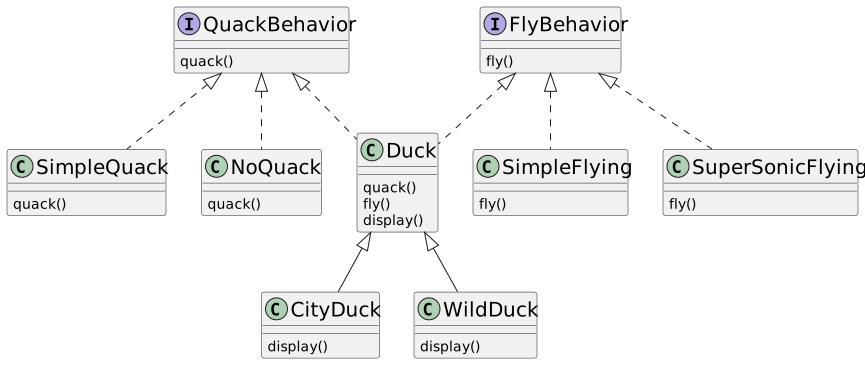
Strategy Design Pattern: Intent of Strategy Pattern
The intent of the Strategy pattern is to define a set of interchangeable algorithms or strategies that can be selected at runtime according to the needs of the context or client.
Strategy Design Pattern: Problem and Solution
Problem: Need for a flexible way to incorporate different behaviors or algorithms within a class and the ability to change them at runtime.
Solution: The Strategy pattern suggests separating the behavior into different strategy classes and using a reference to these strategies in the context class.
Problem with Inheritance: Adding Fly Method
- Adding
flymethod to Duck class leads to issues. - Not all ducks should fly (e.g., rubber ducks).
public class Duck {
    public void fly() {
        // Flying behavior
    }
}
Strategy Pattern Solution: Encapsulating Behaviors
- Separate
flyandquackbehaviors into different strategies. - Each duck type can have its own flying and quacking behavior.
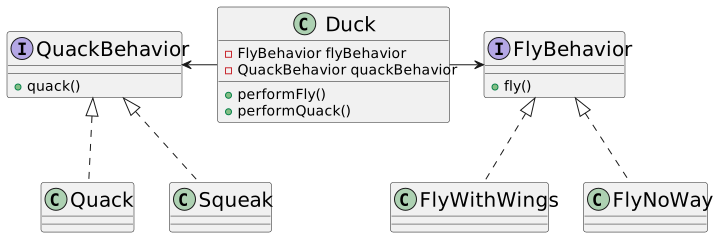
Implementing Duck Subclasses
Different types of ducks inherit from Duck class.
Each subclass implements its own display method.
public class MountainDuck extends Duck {
    public MountainDuck() {
        quackBehavior = new Quack();
        flyBehavior = new FlyWithWings();
    }
    public void display() {
        // MallardDuck specific display
    }
}
Advantages of Strategy Pattern
Promotes flexible code structure.
Allows behaviors to change dynamically.
Reduces dependency on inheritance.
Decoupling Behaviors
Behaviors are not hard-coded in the Duck class.
They can vary independently from the duck type.
public class Duck {
    FlyBehavior flyBehavior;
    QuackBehavior quackBehavior;

    public void performFly() {
        flyBehavior.fly();
    }

    public void performQuack() {
        quackBehavior.quack();
    }
}
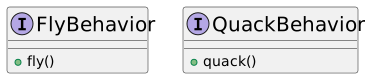
Defining Behavior Interfaces
- Define interfaces for each behavior.
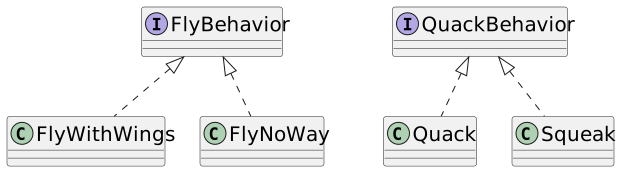
Concrete Implementations
- Implement different flying and quacking behaviors.
Strategy Pattern in Duck Subclasses
- Subclasses of Duck can choose different behaviors.
public class RubberDuck extends Duck {
    public RubberDuck() {
        flyBehavior = new FlyNoWay();
        quackBehavior = new Squeak();
    }
    public void display() {
        // RubberDuck specific display
    }
}
Strategy Pattern: Flexibility
- Easy to add new behaviors without modifying existing classes.
public class JetFlyingBehavior implements FlyBehavior {
    public void fly() {
        // Jet-powered flying
    }
}
Problem: Code Duplication in Inheritance
- Inheritance can lead to duplicated code across subclasses.
Solving Code Duplication
- Strategy Pattern avoids duplication by sharing behavior implementations.
Strategy Pattern in Context
- Allows ducks to have various combinations of behaviors.
- Easy to maintain and extend.
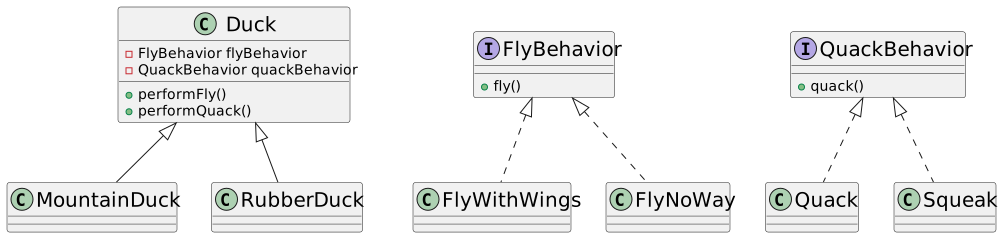
Strategy Design Pattern: Structure of Strategy Pattern {style=“font-size: 70%;”}
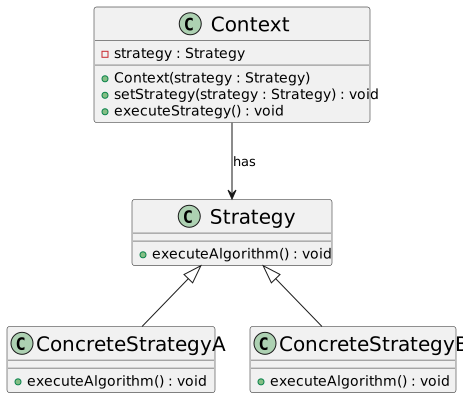
Context: Maintains a reference to a Strategy object and delegates it the algorithm execution.
Strategy: Common interface for all strategies defining the algorithm execution method.
ConcreteStrategy: Implements the algorithm using the Strategy interface.
Strategy Design Pattern: Implementation in Java: Context and Strategy
// Strategy Interface
interface Strategy {
    void executeAlgorithm();
}

// Context Class
class Context {
    private Strategy strategy;

    Context(Strategy strategy) {
        this.strategy = strategy;
    }

    void setStrategy(Strategy strategy) {
        this.strategy = strategy;
    }

    void executeStrategy() {
        strategy.executeAlgorithm();
    }
}
Strategy Design Pattern: Concrete Strategies in Java
// Concrete Strategy A
class ConcreteStrategyA implements Strategy {
    public void executeAlgorithm() {
        // Implement algorithm A
    }
}

// Concrete Strategy B
class ConcreteStrategyB implements Strategy {
    public void executeAlgorithm() {
        // Implement algorithm B
    }
}
Strategy Design Pattern: Applicability
Use the Strategy pattern when:
You have different variations of an algorithm and want to switch between them at runtime.
You want to avoid exposing complex, algorithm-specific data structures.
You want to replace inheritance with composition for behavioral variations.
Strategy Design Pattern: Pros and Cons {style=“font-size: 80%;”}
Pros:
Enables the Open/Closed Principle by allowing the introduction of new strategies without changing the context.
Simplifies unit testing by isolating algorithms.
Cons:
Increases the number of objects in the application.
Clients must be aware of the differences between strategies to select the right one.
Observer Pattern
Weather Station and Display
Understanding the Problem
- Scenario: When an object changes its state, other objects need to be notified.
- Challenge: Continuously checking (polling) the state of an object is inefficient.
Basics of Observer Pattern
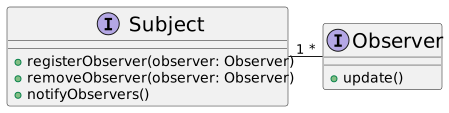
- Definition: A design pattern where an object, known as the subject, notifies a list of observers about its state changes.
- Key Concept: Push vs. Pull notification (move from pull to push).
Observer Pattern: Intent
Observer pattern allows for the establishment of a subscription mechanism to notify multiple objects about any events that happen to the object they’re observing.
Observer Pattern: Problem and Solution
Problem: Managing knowledge about changes in a system’s state can be complex when multiple entities need updates.
Solution: Observer pattern offers a subscription model where subjects notify observers about changes, promoting decoupling and efficient data distribution.
UML Diagram: Basic Structure
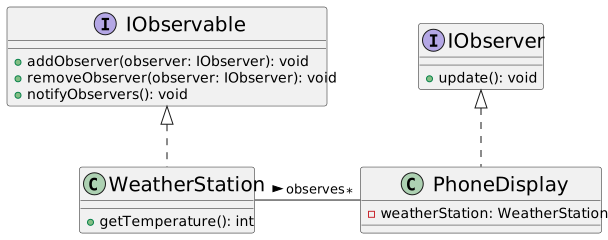
Real-World Example: Weather Station
- Observable: Weather Station measuring and updating weather data.
- Observers: Displays (e.g., phone display, window display) showing updated weather.
UML Diagram: Weather Station Example
Java Implementation: Interfaces
public interface Observer {
  void update();
}

public interface Observable {
  void addObserver(Observer o);
  void removeObserver(Observer o);
  void notifyObservers();
}
Java Implementation: WeatherStation
public class WeatherStation implements Observable {
  private List<Observer> observers;
  private int temperature;

  // Methods implementation...
}
Java Implementation: PhoneDisplay
public class PhoneDisplay implements Observer {
  private WeatherStation weatherStation;

  public void update() {
    // Implementation...
  }
}
Advantages of Observer Pattern
- Reduces Coupling: Observers are loosely coupled with the subject.
- Real-time Update: Efficient update mechanism for state changes.
Observer Pattern: Push vs. Pull
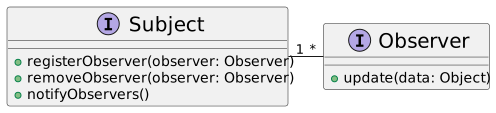
Push Model: Subject sends detailed data to observers.
Pull Model: Observers request data from the subject.
UML Diagram: Push Model
UML Diagram: Pull Model
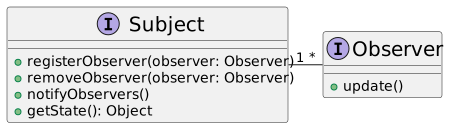
Java Implementation: Push Model
public interface Observer {
  void update(Object data);
}

public class ConcreteObserver implements Observer {
  public void update(Object data) {
    // Use data directly
  }
}
Java Implementation: Pull Model
public interface Observer {
  void update();
}

public class ConcreteObserver implements Observer {
  private ConcreteSubject subject;

  public void update() {
    Object data = subject.getState();
    // Use data
  }
}
Registering Observers
- Observers must register themselves to the subject.
- Allows dynamic addition and removal of observers.
Java Code: Observer Registration
public class Main {
  public static void main(String[] args) {
    WeatherStation station = new WeatherStation();
    PhoneDisplay display = new PhoneDisplay(station);
    station.addObserver(display);
  }
}
Benefits of Observer Pattern
- Scalability: Easily add new observers without modifying the subject.
- Flexibility: Supports both push and pull data models.
Observer Pattern: Limitations
- Potential for Memory Leaks: Observers need to be explicitly removed.
- Unexpected Updates: Observers might receive updates at unpredictable times.
Summary and Conclusion
- Observer Pattern is crucial for state change notification in software design.
- Offers a robust, scalable, and flexible solution for maintaining consistency across different parts of a system.
- Suitable for various applications like UI, weather monitoring, and more.
See you in Lab! 👋🏼 {.LastSlide background-color=“#f3d8cb”}
Footnotes
Really they don’t, don’t google it.↩︎