Understanding Object-Oriented Programming (OOP)
OOP is a paradigm based on encapsulating data and behavior into objects.
Objects are constructed from classes, which are blueprints for creating instances.
Key Concepts: Objects, Classes.
Objects and Classes in OOP
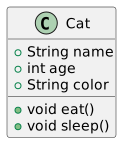
Objects are instances of classes with attributes (state) and methods (behavior).
Example: A cat named Oscar, an instance of the Cat class.
Diagram:
![]()
Understanding Class Hierarchies
Understanding Class Hierarchies - Classes can be organized into hierarchies, inheriting attributes and behaviors.
Abstraction in OOP
Abstraction in OOP - Abstraction involves creating simplified models of complex real-world objects.
Encapsulation: Protecting Data
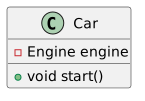
Encapsulation hides the internal state and behavior of objects, exposing only what is necessary.
Example: Starting a car with a key.
Diagram:
![]()
Inheritance: Reusing Code
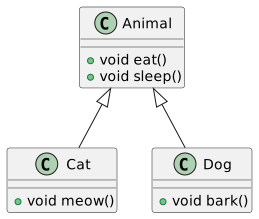
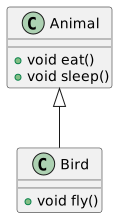
Inheritance allows new classes to be built upon existing ones, promoting code reuse.
Key Concept: Subclasses inherit and extend superclasses.
Diagram:
![]()
Polymorphism: Flexible Interfaces
Polymorphism enables objects of different classes to be treated as objects of a common superclass.
Example: Treating Cats and Dogs as Animals.
Key Concept: Objects can “pretend” to be instances of their superclass.
Exploring Relationships Between Objects
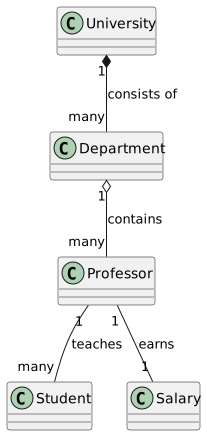
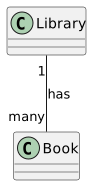
Objects relate in several ways: association, dependency, composition, and aggregation.
Key Concepts: Association, Dependency, Composition, Aggregation.
Diagram:
![]()
Deep Dive into Abstraction
Abstraction simplifies complex reality by modeling classes based on the essential characteristics relevant to the context.
Example: Modeling different types of vehicles (Cars, Bicycles) in a transportation simulation.
Key Concept: Focus on essential qualities relevant to the application while ignoring irrelevant details.
Abstraction in Practice
Effective abstraction helps manage complexity by reducing and isolating change impacts.
Example: In a banking app, abstracting Account allows focusing on shared operations like deposit and withdraw without worrying about specifics like Checking or Savings.
Deep Dive into Encapsulation
Deep Dive into Encapsulation - Encapsulation protects object integrity by hiding its internal state and requiring all interaction to occur via an object’s methods.
- Example: A Document object allowing content manipulation only through specific methods ensures no unauthorized changes are made.
Encapsulation in Practice
Encapsulation reduces system complexity and increases robustness by preventing external entities from depending on internal details.
Example: A User class encapsulates age and only allows setting it via a valid date of birth, ensuring age is always accurate and valid.
Deep Dive into Inheritance
Inheritance promotes code reuse by allowing new classes to inherit properties and behaviors from existing classes.
Example: A Bird class can inherit from Animal, gaining common methods like eat while adding flight-related features.
Diagram:
![]()
Inheritance in Practice
Inheritance simplifies code maintenance and scalability by enabling changes in the superclass to propagate to subclasses.
Example: Enhancing the Animal class with a new behavior automatically provides that behavior to all subclasses like Bird and Cat.
Deep Dive into Polymorphism
Deep Dive into Polymorphism - Polymorphism allows objects of different classes to be treated as objects of a common superclass, enabling flexible and dynamic code.
- Example: An array of Animal objects can hold Cats and Birds, and calling makeSound() on them will produce the appropriate sound for each type.
Polymorphism in Practice
Polymorphism in Practice - Polymorphism facilitates flexibility in code, allowing for dynamic changes and reducing the need for extensive conditionals.
- Example: A game can manage a list of Shape objects and draw each one without knowing its specific type (Circle, Square, etc.).
Understanding Associations in OOP
![]()
Exploring Dependencies in OOP
Exploring Dependencies in OOP - Dependencies indicate that one class uses or relies on the functions of another class.
- Example: In a software application, a Controller class might depend on a Service class to process data.
Composition and Aggregation in OOP
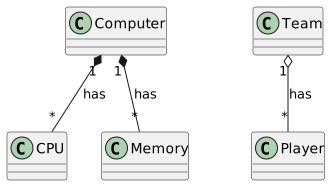
Composition and Aggregation in OOP - Composition and Aggregation are strong and weak ‘has-a’ relationships, respectively.
Composition Example: A Computer class composed of a CPU and Memory implies owning these parts.
Aggregation Example: A Team class aggregating Player objects implies the players can exist independently of the team.
Diagram:
![]()
Summary of Object-Oriented Principles
OOP is based on key principles like Encapsulation, Abstraction, Inheritance, and Polymorphism, which work together to create flexible, maintainable, and scalable software.
Understanding and applying these principles allows for designing systems that are robust and adaptable to change.
Remember to consider the balance between complexity and benefit when applying these principles to ensure they provide value to your project.