Design Pattern
BCS1430
Dr. Ashish Sai
📅 Week 5 Lecture 1
💻 BCS1430.ashish.nl
📍 EPD150 MSM Conference Hall
Structural Design Patterns
Structural patterns focus on assembling objects and classes into larger structures while maintaining efficiency and flexibility.
All Structural Patterns
| Pattern | Description | Covered |
|---|---|---|
| Adapter | Allows the interface of an existing class to be used as another interface. | ✅ |
| Bridge | Separates an object’s abstraction from its implementation so that they can vary independently. | ❌ |
| Composite | Composes objects into tree structures to represent part-whole hierarchies. | ❌ |
| Decorator | Attaches additional responsibilities to an object dynamically. | ✅ |
| Facade | Provides a unified interface to a set of interfaces in a subsystem. | ✅ |
| Flyweight | Uses sharing to support a large number of fine-grained objects efficiently. | ❌ |
| Proxy | Provides a surrogate or placeholder for another object to control access to it. | ✅ |
Decorator Pattern
Espresso Yourself Café
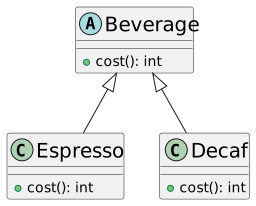
- You want to offer an option of add-ons (caramel, soy milk etc)
Oh no!

The Problem Statement
The need to extend the functionality of objects dynamically.
Avoiding “class explosion” for similar yet distinct objects.
Example: Different types of coffee in a coffee house application.
Class Explosion Problem
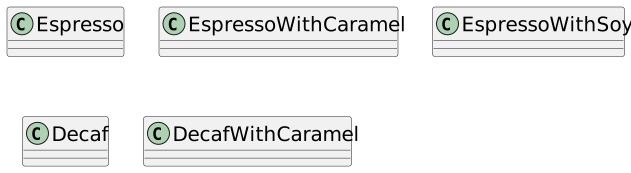
Multiple classes for each combination of coffee and add-ons (e.g., Espresso with Caramel, Decaf with Soy, etc.).
Results in a large, unmanageable number of subclasses.
How to solve it?
Introduction to the Decorator Pattern
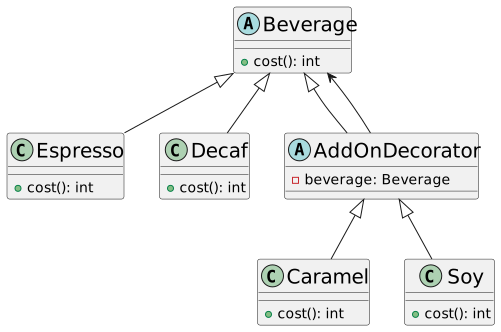
Purpose: Dynamically adds behaviors to objects without modifying their structure.
Key Concept: Wraps additional behaviors around objects to enhance or modify their functionality.
Decorator Pattern: Intent
- Attach new behaviors to objects dynamically.
- Provide a flexible alternative to subclassing for extending functionality.
Decorator Pattern: Issues with Subclassing
- Combinatorial explosion of subclasses.
- Inflexibility to combine multiple behaviors dynamically.
How It Works
Wraps the original object inside objects containing new behaviors.
Each wrapper (decorator) adds its behavior either before or after delegating to the wrapped object.
Decorator Pattern Structure
Applying Decorator Pattern - Example
- Decorators for each add-on (e.g., caramel, soy milk).
Concrete Decorators
public class CaramelDecorator extends AddOnDecorator {
    public CaramelDecorator(Beverage beverage) {
        this.beverage = beverage;
    }

    public int cost() {
        return beverage.cost() + 2; // Adding cost of caramel
    }
}

public class SoyDecorator extends AddOnDecorator {
    public SoyDecorator(Beverage beverage) {
        this.beverage = beverage;
    }

    public int cost() {
        return beverage.cost() + 1; // Adding cost of soy
    }
}
Decorator Pattern in Action
Creating a coffee with add-ons.
Calculating the total cost dynamically.
Decorator Pattern: Decorator Pattern Structure
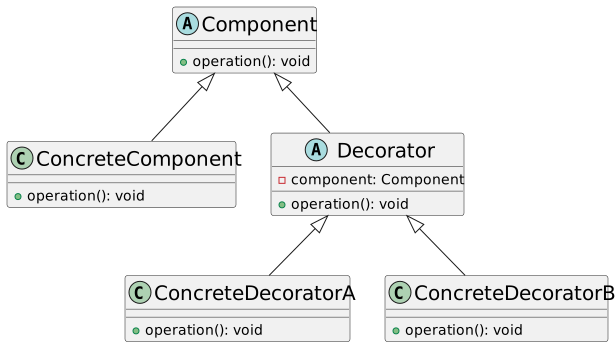
Component: Common interface for both wrappers and wrapped objects.
Concrete Component: The object being wrapped.
Decorator: Base class for all decorators with a reference to a Component.
Concrete Decorators: Classes that add new behaviors.
Decorator Pattern: Implementing the Decorator Pattern
Steps for Implementation
Define the component interface.
Create a concrete component class.
Develop a base decorator class.
Implement concrete decorators.
Decorator Pattern: Key Considerations
Ensure all components and decorators implement the component interface.
Decorators should delegate to the wrapped object and add their behavior.
Another Problem
You have a different types of data sources (such as Text Files or Database)
You want to Encrypt the data yous tore or Compress it.
Java Example - Base Component and Decorator
// Component Interface
interface DataSource {
    void writeData(String data);
    String readData();
}

// Concrete Component
class FileDataSource implements DataSource {
    // Implementation details...
}

// Base Decorator
class DataSourceDecorator implements DataSource {
    protected DataSource wrappee;

    DataSourceDecorator(DataSource source) {
        this.wrappee = source;
    }

    public void writeData(String data) {
        wrappee.writeData(data);
    }

    public String readData() {
        return wrappee.readData();
    }
}- The base decorator delegates all work to the wrapped component.
Decorator Pattern: Java Example - Concrete Decorators
// Encryption Decorator
class EncryptionDecorator extends DataSourceDecorator {
    EncryptionDecorator(DataSource source) {
        super(source);
    }

    public void writeData(String data) {
        // Encrypt and write data
    }

    public String readData() {
        // Read and decrypt data
        return "decrypted data";
    }
}

// Compression Decorator
class CompressionDecorator extends DataSourceDecorator {
    CompressionDecorator(DataSource source) {
        super(source);
    }

    public void writeData(String data) {
        // Compress and write data
    }

    public String readData() {
        // Read and decompress data
        return "decompressed data";
    }
}- Each decorator adds its behavior either before or after calling the wrapped object.
Decorator Pattern: Using the Decorator Pattern
The Decorator Pattern allows stacking multiple decorators to add several behaviors.
- Dynamic Behavior Addition
DataSource basicData = new FileDataSource("data.txt");
DataSource encrypted = new EncryptionDecorator(basicData);
DataSource encryptedCompressed = new CompressionDecorator(encrypted);

// Now 'encryptedCompressed' has both encryption and compression capabilities.- The client code can combine decorators in various configurations at runtime.
Benefits of Decorator Pattern
Flexibility in adding new functionality.
Avoids class explosion by using composition over inheritance.
Easier to maintain and extend.
Limitations of Decorator Pattern
Can lead to complex code structures.
Difficulty in debugging, as it introduces layers of abstraction.
Potential performance issues due to increased object creation.
Decorator Pattern vs Subclassing
Decorator Pattern allows for more flexibility than subclassing.
Avoids rigid class hierarchy.
Promotes loose coupling and adherence to the Open-Closed Principle.
Adapter Design Pattern
The Adapter Pattern
Purpose: To make two incompatible interfaces compatible.
Also known as a “wrapper.”
Use Case: Connecting new code to legacy code or third-party libraries.
Adapter Pattern UML Diagram
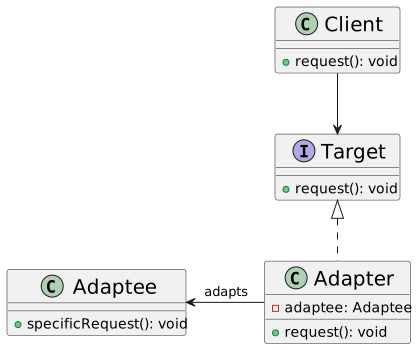
Adapter Pattern Java Example
public class Client {
  Target target = new Adapter (new Adaptee());
  target.request();
}

public interface Target {
  void request();
}

class Adapter implements Target {
public Adapter (Adaptee a){
  this.adaptee = a;
}
public void request(){
  this.adaptee.SpecialRequest();
}

}

class Adaptee {

void specialRequest(){

}

}
Adapter Pattern: Intent of Adapter Pattern
The Adapter pattern allows objects with incompatible interfaces to work together.
It acts as a bridge between two incompatible interfaces, effectively allowing them to communicate.
Adapter Pattern: The Problem
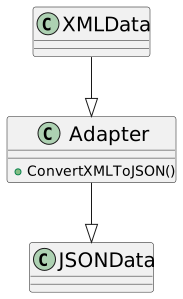
Scenario: Stock market monitoring app downloads data in XML.
Challenge: Integration with a 3rd-party analytics library requiring JSON.
Problem: Incompatibility between data formats (XML vs. JSON).

Adapter Pattern: The Solution
Enables collaboration by converting XML interface for Analytics Library compatibility.
Adapter Pattern: Applicability of Adapter Pattern
Purpose: To use an existing class whose interface is incompatible with your code.
Ideal For:
- Integrating new classes with old ones.
- Working with 3rd-party libraries.
Adapter Pattern: Pros and Cons
Pros:
Single Responsibility Principle: Separates the interface conversion code from the primary business logic.
Open/Closed Principle: Allows introducing new types of adapters without breaking existing client code.
Cons:
- Increases overall complexity due to the introduction of new interfaces and classes.
The Facade Pattern
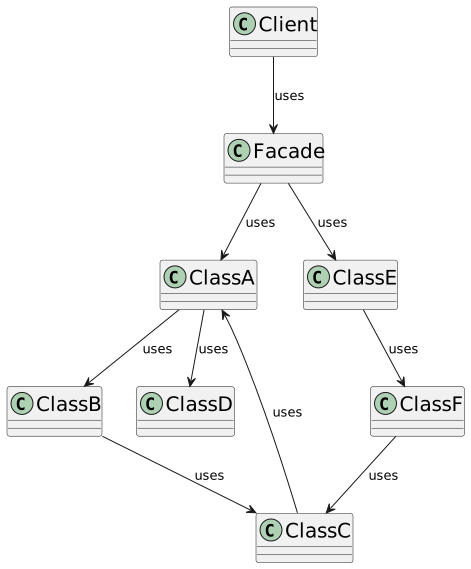
The Facade Pattern - Overview
Definition: Simplifies complex system interactions
Purpose: Provide a unified interface to a set of interfaces in a subsystem
Key Principle: High-level abstraction over complex subsystems
Example: Starting a car (Key Turn → Engine Start, Lights On, etc.)
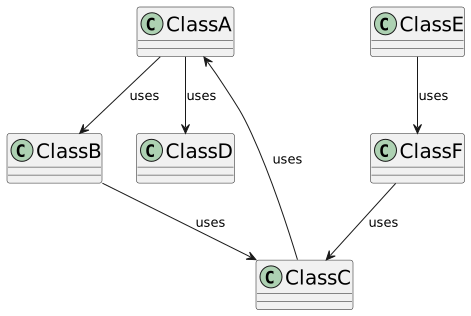
Understanding System Complexity
Multiple classes with intricate interactions
Challenge: Managing complex dependencies and interactions
The Client’s Perspective
Client: User of a piece of code, not end-user
Problem: Need to interact with complex subsystems
The Need for the Facade Pattern
Complexity: High due to multiple, interdependent classes
Solution: Simplify interaction using a facade
Facade Pattern: Real-World Analogy
Consider an operator in a shop as a facade. They provide you with a simple interface to various services and departments of the shop, hiding the complexities of the subsystems behind the scenes.
Facade Pattern
Facade Pattern Java Example
// Facade Class
public class CarEngineFacade {
    private Ignition ignition;
    private FuelInjector fuelInjector;
    private AirFlowController airFlowController;

    public CarEngineFacade() {
        ignition = new Ignition();
        fuelInjector = new FuelInjector();
        airFlowController = new AirFlowController();
    }

    public void startEngine() {
        fuelInjector.on();
        airFlowController.takeAir();
        ignition.ignite();
        // Other complex interactions
    }

    public void stopEngine() {
        fuelInjector.off();
        airFlow

Controller.cutAir();
        ignition.off();
        // Other shutdown interactions
    }
}
Advantages of Facade Pattern
Simplicity: Provides simple interface to complex subsystems
Decoupling: Clients interact with facade rather than direct subsystem
Maintainability: Changes in subsystems less likely to affect clients
Facade Pattern: Relations with Other Patterns
- Adapter vs. Facade: Adapter wraps one object, while Facade works with an entire subsystem of objects.
- Facade and Singleton: Often, a single facade object is sufficient, making it a good candidate for a Singleton.
Proxy Pattern
Introduction to Proxy Pattern
Provides a surrogate or placeholder for another object.
Controls access to the original object.
Use cases: Security, Remote Object Access etc.
Intent of Proxy Pattern
Purpose: Acts as a substitute to control access to another object.
Use Cases: Ideal for scenarios needing object access management without changing the object’s behavior.
Proxy Pattern: Real-World Analogy
A real-world analogy for the Proxy pattern is a credit card acting as a proxy for a bank account, which in turn is a proxy for a bundle of cash. Both provide a means for payment but with additional layers of control and convenience.
Types of Proxy Patterns
- Remote Proxy: Facilitates access to objects located in different address spaces.
- Virtual Proxy: Delays the creation and initialization of expensive objects until needed.
- Protection Proxy: Controls access to an object based on access rights.
The Problem
- Access management for resource-intensive objects or services.
- Security assurance complexities.
- Simplification of remote service access.
The Solution
- Act as an intermediary for controlling access.
- Add Abstraction: Provides a layer to handle security, manage initialization, and simplify remote access.
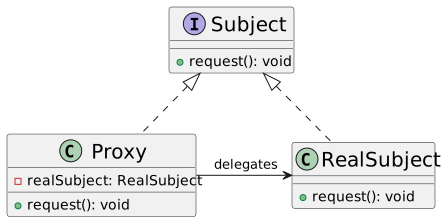
Proxy Pattern UML Diagram
Implementation Examples (Virtual Proxy)
public interface Image {
    void display();
}
public class RealImage implements Image {
    private String fileName;
    public RealImage(String fileName) {
        this.fileName = fileName;
        loadFromDisk(fileName);
    }
    @Override
    public void display() {
        System.out.println("Displaying " + fileName);
    }
    private void loadFromDisk(String fileName) {
        System.out.println("Loading " + fileName);
    }
}

public class ProxyImage implements Image {
    private RealImage realImage;
    private String fileName;
    public ProxyImage(String fileName) {
        this.fileName = fileName;
    }
    @Override
    public void display() {
        if (realImage == null) {
            realImage = new RealImage(fileName);
        }
        realImage.display();
    }
}
Protection Proxy Example in Java
public interface SecureResource {
    void accessResource();
}
public class RealResource implements SecureResource {
    @Override
    public void accessResource() {
        System.out.println("Accessing Secure Resource");
    }
}
public class SecurityProxy implements SecureResource {
    private RealResource realResource;
    private boolean hasAccess;
    public SecurityProxy(boolean hasAccess) {
        this.hasAccess = hasAccess;
        this.realResource = new RealResource();
    }
    @Override
    public void accessResource() {
        if (hasAccess) {
            realResource.accessResource();
        } else {
            System.out.println("Access Denied");
        }
    }
}
Applicability of Proxy Pattern
The Proxy Pattern is highly versatile, applicable in situations requiring:
- Lazy initialization (Virtual Proxy)
- Access control (Protection Proxy)
- Remote object access (Remote Proxy)
- Other use cases like logging, caching, or auditing access
Proxy Pattern: Pros and Cons
Pros:
Control the service object indirectly.
Manage the lifecycle and initialization of the service.
Introduce new proxies without changing the service or clients.
Cons:
Can complicate the code structure with additional classes.
May introduce latency in the response from the service.