Design Pattern: Behavioral Patterns
Behavioral Design Patterns
Behavioral patterns in software design focus on effective communication and the assignment of responsibilities among objects.
Behavioral Patterns
| Pattern | Description | Covered |
|---|---|---|
| Observer | Defines a one-to-many dependency between objects so that when one object changes state, all its dependents are notified and updated automatically. | ✅ |
| Strategy | Defines a family of algorithms, encapsulates each one, and makes them interchangeable. Strategy lets the algorithm vary independently from clients that use it. | ✅ |
| Command | Encapsulates a request as an object, thereby allowing for parameterization of clients with queues, requests, and operations. | ✅ |
| State | Allows an object to alter its behavior when its internal state changes. The object will appear to change its class. | ✅ |
| Chain of Responsibility | Passes the request along the chain of handlers. Upon receiving a request, each handler decides either to process the request or to pass it to the next handler in the chain. | ❌ |
| Interpreter | Provides a way to evaluate language grammar or expressions. The Interpreter pattern defines a grammar for the language, as well as an interpreter that uses the grammar to interpret sentences in the language. | ❌ |
| Memento | Captures and externalizes an object’s internal state so the object can be restored to this state later. | ❌ |
| Visitor | Represents an operation to be performed on the elements of an object structure. Visitor lets you define a new operation without changing the classes of the elements on which it operates. | ❌ |
| Template Method | Defines the skeleton of an algorithm in the method, deferring some steps to subclasses. Template Method lets subclasses redefine certain steps of an algorithm without changing its structure. | ✅ |
Strategy Pattern
Strategy Pattern
The strategy pattern is a fundamental design pattern that is essential for understanding composition over inheritance. It is defined as:
- Defining a family of algorithms
- Encapsulating each algorithm
- Making them interchangeable
Inheritance vs. Composition
- Inheritance is not always intended for code reuse.
- Composition offers greater flexibility in many scenarios.
- Strategy Pattern focuses on using composition over inheritance.
Problem Statement: Duck Example
- Consider a system with different types of ducks.
- Each duck type has its own display method.
- Common methods like
quackare shared.
Introducing the Strategy Pattern
- The Strategy Pattern allows the duck’s behaviors to vary independently.
- Encapsulates quacking and flying behaviors.

Problem with Inheritance: Adding Fly Method
- Adding
flymethod to Duck class leads to issues. - Not all ducks should fly (e.g., rubber ducks).
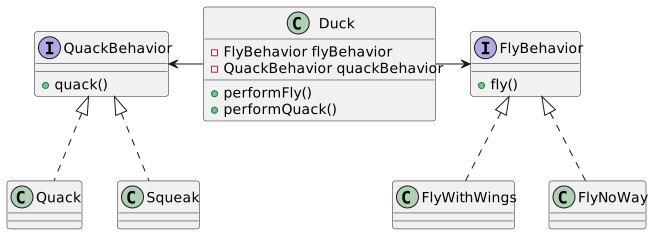
Strategy Pattern Solution: Encapsulating Behaviors
- Separate
flyandquackbehaviors into different strategies. - Each duck type can have its own flying and quacking behavior.
Implementing Duck Subclasses
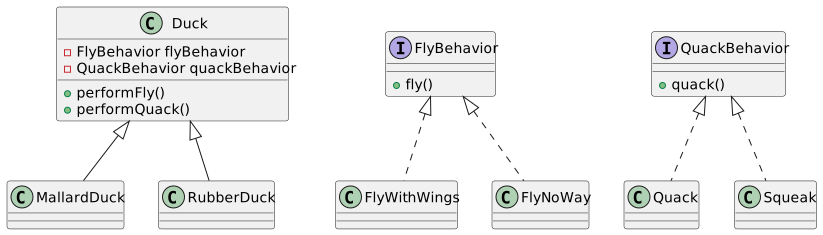
Different types of ducks inherit from Duck class.
Each subclass implements its own display method.
Advantages of Strategy Pattern
Promotes flexible code structure.
Allows behaviors to change dynamically.
Reduces dependency on inheritance.
Decoupling Behaviors
Behaviors are not hard-coded in the Duck class.
They can vary independently from the duck type.
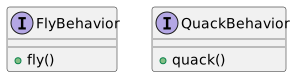
Defining Behavior Interfaces
- Define interfaces for each behavior.
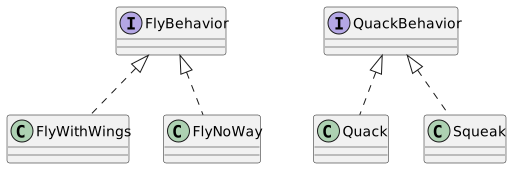
Concrete Implementations
- Implement different flying and quacking behaviors.
Strategy Pattern in Duck Subclasses
- Subclasses of Duck can choose different behaviors.
Strategy Pattern: Flexibility
- Easy to add new behaviors without modifying existing classes.
Problem: Code Duplication in Inheritance
- Inheritance can lead to duplicated code across subclasses.
Solving Code Duplication
- Strategy Pattern avoids duplication by sharing behavior implementations.
Dependency Injection
- Behaviors are injected into Duck instances.
- Increases flexibility and testability.
Strategy Pattern in Context
- Allows ducks to have various combinations of behaviors.
- Easy to maintain and extend.
Conclusion: Strategy Pattern
The Strategy Pattern is a powerful tool for creating flexible, maintainable code.
Encourages composition over inheritance.
Enables dynamic behavior assignment.
Observer Pattern
Understanding the Problem
- Scenario: When an object changes its state, other objects need to be notified.
- Challenge: Continuously checking (polling) the state of an object is inefficient.
Basics of Observer Pattern
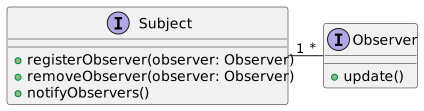
- Definition: A design pattern where an object, known as the subject, notifies a list of observers about its state changes.
- Key Concept: Push vs. Pull notification.
UML Diagram: Basic Structure
Real-World Example: Weather Station
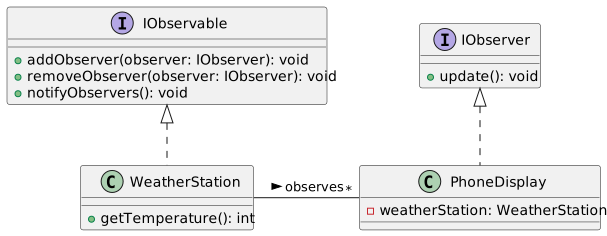
- Observable: Weather Station measuring and updating weather data.
- Observers: Displays (e.g., phone display, window display) showing updated weather.
UML Diagram: Weather Station Example
Java Implementation: Interfaces
Java Implementation: WeatherStation
Java Implementation: PhoneDisplay
Advantages of Observer Pattern
- Reduces Coupling: Observers are loosely coupled with the subject.
- Real-time Update: Efficient update mechanism for state changes.
Observer Pattern: Push vs. Pull
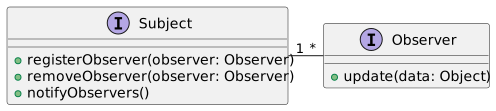
Push Model: Subject sends detailed data to observers.
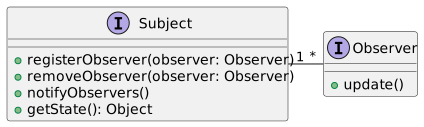
Pull Model: Observers request data from the subject.
UML Diagram: Push Model
UML Diagram: Pull Model
Java Implementation: Push Model
Java Implementation: Pull Model
Registering Observers
- Observers must register themselves to the subject.
- Allows dynamic addition and removal of observers.
Java Code: Observer Registration
Benefits of Observer Pattern
- Scalability: Easily add new observers without modifying the subject.
- Flexibility: Supports both push and pull data models.
Observer Pattern: Limitations
- Potential for Memory Leaks: Observers need to be explicitly removed.
- Unexpected Updates: Observers might receive updates at unpredictable times.
Summary and Conclusion
- Observer Pattern is crucial for state change notification in software design.
- Offers a robust, scalable, and flexible solution for maintaining consistency across different parts of a system.
- Suitable for various applications like UI, weather monitoring, and more.
Command Pattern
Introduction to the Command Pattern
Origin: Discussed in “Head First Design Patterns” and “Design Patterns: Elements of Reusable Object-Oriented Software” by the Gang of Four.
Purpose: Encapsulates a request as an object.
Benefits:
Parameterization of objects with different requests.
Enabling queuing or logging of requests.
Supporting undoable operations.
Basic Concept
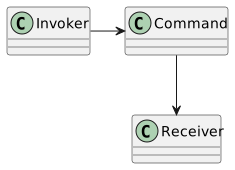
Command Pattern Structure:
Command: An object encapsulating a request.
Invoker: Sends the command.
Receiver: The object receiving and executing the request.
Real-World Example: Smart Home Automation
Scenario: Controlling smart devices like lights, thermostats.
Application: Creating a smartphone app for device control.
Encapsulating Commands
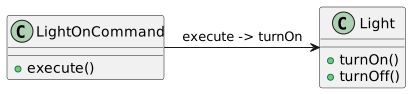
Objective: Encapsulate each action (e.g., turning on a light) as a command.
Advantage: Commands can be passed and manipulated independently of the receiver.
Parameterizing Objects with Commands
Concept: Objects can be configured with commands to perform various actions.
Example: A remote control with buttons assigned to different light commands.
Command Queuing and Logging
Queuing: Store and execute commands in sequence.
Logging: Keep a record of executed commands for auditing or replaying.
Supporting Undoable Operations
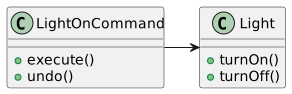
Implementation: Each command has an
executeandundomethod.Use Case: Reversing a command, like turning off a light that was turned on.
Java Example: Command Interface
- Role: Define a common interface for all commands.
Java Example: Concrete Command
public class LightOnCommand implements Command {
    private Light light;

    public LightOnCommand(Light light) {
        this.light = light;
    }

    public void execute() {
        light.turnOn();
    }

    public void

undo() {
        light.turnOff();
    }
}- Explanation:
LightOnCommandencapsulates the action of turning on a light.
Java Example: Invoker Implementation
public class RemoteControl {
    private Command[] commands;

    public RemoteControl() {
        commands = new Command[4]; // Assuming 4 buttons
    }

    public void setCommand(int slot, Command command) {
        commands[slot] = command;
    }

    public void buttonPressed(int slot) {
        if (commands[slot] != null) {
            commands[slot].execute();
        }
    }
}- Role of
RemoteControl: Acts as an invoker that triggers commands.
Dependency Injection in Command Pattern
- Purpose: To dynamically assign a receiver to a command.
- Benefit: Increases flexibility and decouples command from specific receivers.
Macro Commands
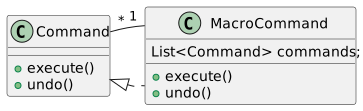
Concept: A command that contains multiple commands.
Use Case: Executing a batch of commands with a single action.
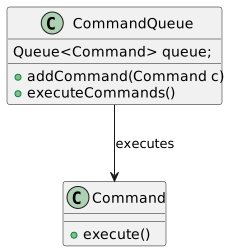
Queueing Commands
Implementation: Commands can be added to a queue and executed in order.
Application: Useful for scheduling and executing tasks sequentially.
Undo Mechanism
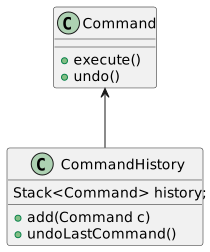
Concept: Providing an
undomethod in each command to reverse its action.Implementation: Storing the history of executed commands for undo operations.
Java Example: Undo Functionality
public class RemoteControlWithUndo {
    private Command[] commands;
    private Stack<Command> history = new Stack<>();

    public void setCommand(int slot, Command command) {
        commands[slot] = command;
    }

    public void pressedButton(int slot) {
        if (commands[slot] != null) {
            commands[slot].execute();
            history.push(commands[slot]);
        }
    }

    public void pressedUndo() {
        if (!history.isEmpty()) {
            history.pop().undo();
        }
    }
}- Note:
RemoteControlWithUndokeeps track of command history for undo operations.
Advantages of Command Pattern
Flexibility: Commands can be added, removed, or modified independently.
Reusability: Commands can be used across different contexts and applications.
Extensibility: Easy to add new commands without changing existing code.
Command Pattern in User Interfaces
Application: Assigning commands to UI elements like buttons, menus.
Example: A toolbar with buttons executing different commands in an application.
Composite Command Pattern
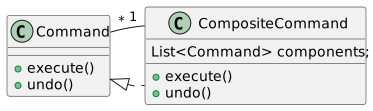
Concept: Combining multiple commands into a single composite command.
Use Case: Complex operations that require executing several commands in a sequence.
Implementing Command Pattern in Different Programming Paradigms
Object-Oriented Programming: Encapsulating actions as objects.
Functional Programming: Treating functions as first-class citizens, similar to commands in OOP.
Summary and Key Takeaways
Command Pattern: Encapsulates requests as objects, offering flexibility and extensibility.
Key Components: Command, Invoker, Receiver.
Benefits:
Decoupling of command execution from its invocation.
Support for undo operations.
Enhanced control over operations, including queuing and logging.
Applications: Widely used in GUIs, transactional systems, and more.
State design pattern
State Design Pattern
Objective: Understand the State design pattern in object-oriented programming.
Context: Managing states and behaviors in software systems.
Application: Example of a turnstile system in a subway.
Understanding State Machines
A state machine is a well-studied concept in computer science.
Deals with states and transitions.
Memoryless: Decisions based on current state, not history.
Why State Pattern?
Simplifies State Management: Clear structure for managing states.
Reduces Complexity: Avoids tangled conditional logic.
Adaptability: Easy to modify and add new states.
Basic Concept of State Pattern
Object Behaviors: Change based on its state.
No Direct Dependency: On the history of how the state was reached.
Real-World Example: Turnstile
Scenario: Subway turnstile system.
Focus: Managing turnstile states using State Pattern.
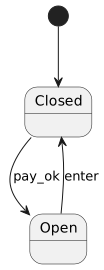
Initial State Diagram of Turnstile
States of a Turnstile
Closed: Default state. Cannot pass through.
Open: Allows passage. Transitions to closed after entry.
Transitions Between States
pay_ok: From Closed to Open.
enter: From Open to Closed.
State Pattern in Java - Basic Structure
public interface State {
    void handleRequest();
}

public class ClosedState implements State {
    public void handleRequest() {
        // Logic for Closed State
    }
}

public class OpenState implements State {
    public void handleRequest() {
        // Logic for Open State
    }
}

public class Turnstile {
    private State state;

    public Turnstile() {
        state = new ClosedState();
    }

    public void setState(State state) {
        this.state = state;
    }

    public void handleRequest() {
        state.handleRequest();
    }
}
Implementing State Transitions in Java
public class ClosedState implements State {
    public void handleRequest() {
        // Transition to Open State
        System.out.println("Payment OK. Gate opening.");
    }
}

public class OpenState implements State {
    public void handleRequest() {
        // Transition to Closed State
        System.out.println("Gate closing after entry.");
    }
}
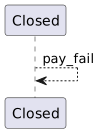
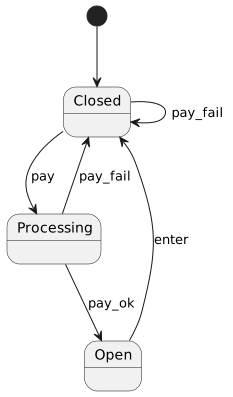
Handling Payment Failures
Scenario: Payment failure at a closed turnstile.
Transition: Remains in Closed state.
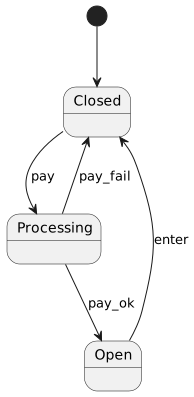
Introduction of Processing State
New State: Processing.
Purpose: Handle payment processing before opening.
Java Implementation of Processing State
Transition Table for Turnstile
| State | Action | Next State |
|---|---|---|
| Closed | pay | Processing |
| Processing | pay_ok | Open |
| Processing | pay_fail | Closed |
| Open | enter | Closed |
Managing State Transitions
Key Concept: Transition based on current state and event.
No Memory: State does not depend on the history of events.
Extending Java Code for New Transitions
Benefits of State Pattern in Complex Systems
Clear State Management: Each state and transition is distinct.
Reduced Complexity: Simplifies complex conditional logic.
Easier Maintenance: Adding new states or transitions is straightforward.
Event Handling in State Pattern
Events: Actions triggering state transitions (e.g., pay, enter).
Handling: Each state defines responses to events.
Visualizing Complex State Transitions
Conclusion and Further Reading
- State Pattern: Powerful tool for managing state in object-oriented design.
- Further Reading: “Design Patterns: Elements of Reusable Object-Oriented Software” by the Gang of Four.
Template Method Pattern
Design Patterns
Fundamental concepts in software engineering.
Solutions to common problems in software design.
They provide a template for how to solve a problem.
Template Method Pattern
One of the behavioral design patterns.
Defines the skeleton of an algorithm in a method, deferring some steps to subclasses.
It lets one redefine certain steps of an algorithm without changing the algorithm’s structure.
Importance
Promotes code reuse.
Provides a clear structure for algorithms.
Facilitates flexibility and customization.
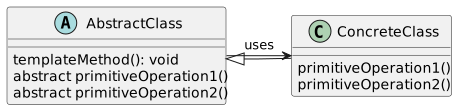
Basic UML Diagram
Java Example: Abstract Class
Concrete Implementation
public class Football extends Game {
    @Override
    protected void initialize() {
        System.out.println("Football Game Initialized.");
    }

    @Override
    protected void startPlay() {
        System.out.println("Football Game Started.");
    }

    @Override
    protected void endPlay() {
        System.out.println("Football Game Finished.");
    }
}
Applying the Template Method
The abstract class defines a template method setting up the structure.
Concrete classes implement these steps without changing the structure.
Allows for customization within a fixed framework.
Benefits
Simplifies code maintenance.
Promotes code reusability and scalability.
Enhances standardization of an algorithm.
Hollywood Principle
“Don’t call us, we’ll call you.”
High-level components make decisions about when to call low-level components.
This principle is integral to the Template Method pattern.
Open/Closed Principle
Classes should be open for extension, but closed for modification.
The Template Method pattern adheres to this principle by allowing extension through subclassing.
Advanced Template Method
Incorporates hooks and operations.
Hooks are optional steps in the algorithm, defined in the abstract class.
Concrete classes can override these hooks to add custom behavior.
Template Method with Hooks
@startuml
abstract class AbstractClass {
    templateMethod(): void {
        primitiveOperation1();
        hook();
        primitiveOperation2();
    }
    abstract primitiveOperation1()
    abstract primitiveOperation2()
    hook() { }
}

class ConcreteClass extends AbstractClass {
    primitiveOperation1()
    primitiveOperation2()
    hook()
}

AbstractClass -> ConcreteClass : uses
@enduml
Java Example: Hooks
public abstract class GameWithHooks {
    // Template method with a hook
    public final void play() {
        initialize();
        startPlay();
        if (addNewGameFeature()) {
            addFeature();
        }
        endPlay();
    }

    // Hook
    protected boolean addNewGameFeature() {
        return false;
    }

    // New feature
    protected void addFeature() {}

    // Other methods same as previous Game example
}
Concrete Implementation with Hooks
Composition vs Inheritance
Template Method often uses inheritance.
However, composition can be a more flexible alternative.
This involves defining the algorithm in a separate class and composing it in concrete classes.
Template Method with Composition
Java Example: Composition
Strategy vs Template Method
Both design patterns are about defining algorithms.
Strategy Pattern allows changing the behavior dynamically.
Template Method defines a fixed algorithm structure, with specific steps being variable.
Liskov Substitution Principle
Subtypes must be substitutable for their base types.
Essential for the Template Method to ensure derived classes can replace base classes without affecting the algorithm.
Real-world Application
Template Method is widely used in frameworks and libraries.
It provides a defined structure while allowing users to extend specific functionality.
Examples: Data parsing libraries, game development frameworks, UI rendering engines.
Iterator Design Pattern
Introduction to the Iterator Pattern
The Iterator Pattern is a fundamental design pattern in object-oriented programming. It provides a way to access the elements of a collection sequentially without revealing the underlying representation of the collection.
This pattern is essential for:
Providing a uniform way to traverse different data structures.
Decoupling the collection objects and the traversal logic.
Next, we’ll explore what collections are and the challenges faced without the Iterator Pattern.
Concept of Collection in Programming
A collection in programming is an object that groups multiple elements into a single unit. Collections are used to store, retrieve, manipulate, and communicate aggregate data.
Examples of collections:
A list of numbers.
A set of unique values.
A map of key-value pairs.
Understanding collections is key to realizing the importance of the Iterator Pattern.
Problem Without Iterator Pattern
Without the Iterator Pattern, traversing different types of collections can be challenging due to:
Diverse collection structures (arrays, trees, graphs).
The necessity to expose internal representation for iteration.
Increased complexity in client code due to direct traversal logic.
This lack of a unified traversal mechanism leads to less maintainable and more error-prone code.
Iterator Pattern Solution Overview
The Iterator Pattern addresses these challenges by:
Providing a standard way to traverse through a collection.
Allowing the collection to manage the iteration logic internally.
Hiding the internal structure of the collection.
It simplifies client code and enhances maintainability.
UML Diagram of Iterator Pattern
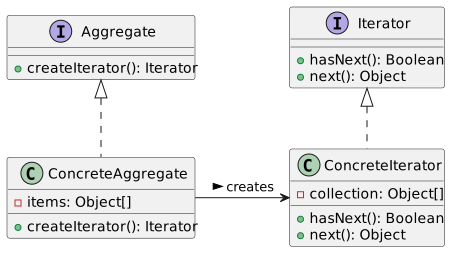
This UML diagram illustrates the core components of the Iterator Pattern:
Iteratorinterface defines the iteration methods.Aggregateinterface provides a method to create an Iterator.ConcreteIteratorimplements the Iterator interface for a specific collection.ConcreteAggregateimplements the Aggregate interface and holds the collection.
Java Code Example: Basic Iterator
Here’s a simple implementation of an Iterator in Java:
public interface Iterator<T> {
    boolean hasNext();
    T next();
}

public class ConcreteIterator<T> implements Iterator<T> {
    private T[] items;
    private int index = 0;

    public ConcreteIterator(T[] items) {
        this.items = items;
    }

    @Override
    public boolean hasNext() {
        return index < items.length;
    }

    @Override
    public T next() {
        return items[index++];
    }
}
This code demonstrates a basic Iterator for an array of generic type T.
Iterator Pattern in Game Development
In game development, the Iterator Pattern can be used to manage collections like:
A list of enemies in a game world.
Inventory items in a player’s backpack.
It allows for efficient traversal and operation on these collections without exposing their internal structure.
UML Diagram: Game World Collection Iteration
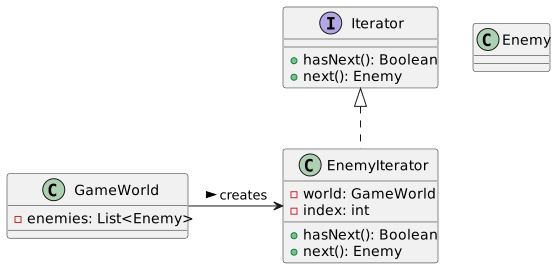
This diagram represents how a GameWorld can create an EnemyIterator to iterate over its collection of enemies.
Java Code Example: Game World Iterator
Implementing an Iterator for a game world’s enemy list:
public class EnemyIterator implements Iterator<Enemy> {
    private GameWorld world;
    private int index;

    public EnemyIterator(GameWorld world) {
        this.world = world;
        this.index = 0;
    }

    @Override
    public boolean hasNext() {
        return index < world.getEnemies().size();
    }

    @Override
    public Enemy next() {
        return world.getEnemies().get(index++);
    }
}
This code snippet shows an Iterator tailored for iterating over enemies in a game world.
Single Responsibility Principle and Iterator Pattern
The Iterator Pattern adheres to the Single Responsibility Principle (SRP) by:
Separating the logic of iterating over a collection from the collection itself.
Allowing each class (iterator and collection) to manage its own responsibilities.
Advanced Iterator Usage in Collections
Advanced usage of iterators allows for more complex operations such as:
Filtering items while iterating.
Applying functions to each item in the collection.
Combining or chaining iterators for complex data structures.
These advanced techniques provide greater flexibility and power in handling collections.
UML Diagram: Advanced Collection Iteration
@startuml
interface Iterator<T> {
  + hasNext(): Boolean
  + next(): T
}

class FilterIterator<T> implements Iterator<T> {
  - wrappedIterator: Iterator<T>
  - filterCondition: Predicate<T>
  + hasNext(): Boolean
  + next(): T
}

Iterator <|.. FilterIterator

@enduml
This diagram shows a FilterIterator that wraps around another iterator, providing additional filtering capabilities based on a given condition.
Java Code Example: Advanced Collection Iterator
Implementing a FilterIterator in Java:
public class FilterIterator<T> implements Iterator<T> {
    private Iterator<T> wrappedIterator;
    private Predicate<T> filterCondition;
    private T nextItem;
    private boolean hasNextItem;

    public FilterIterator(Iterator<T> iterator, Predicate<T> filter) {
        this.wrappedIterator = iterator;
        this.filterCondition = filter;
        advance();
    }

    private void advance() {
        hasNextItem = false;
        while (wrappedIterator.hasNext()) {
            T item = wrappedIterator.next();
            if (filterCondition.test(item)) {
                nextItem = item;
                hasNextItem = true;
                break;
            }
        }
    }

    @Override
    public boolean hasNext() {
        return hasNextItem;
    }

    @Override
    public T next() {
        if (!hasNextItem) {
            throw new NoSuchElementException();
        }
        T item = nextItem;
        advance();
        return item;
    }
}
This code filters items in a collection based on a specified condition while iterating.
Iterator Pattern and Functional Programming
The Iterator Pattern complements functional programming concepts:
Iterators can be used in conjunction with streams and lambda expressions.
Enables operations like
map,filter, andreduceon collections.
This integration brings a declarative approach to collection processing.
Comparison: Foreach Loop and Iterator Pattern
Comparing foreach loop and the Iterator Pattern:
foreachis syntactic sugar over iterators in many languages.Iterators provide more control, e.g., removing elements during iteration.
Understanding this relationship helps in choosing the right iteration mechanism.
UML Diagram: Integrating Iterator with Game Logic
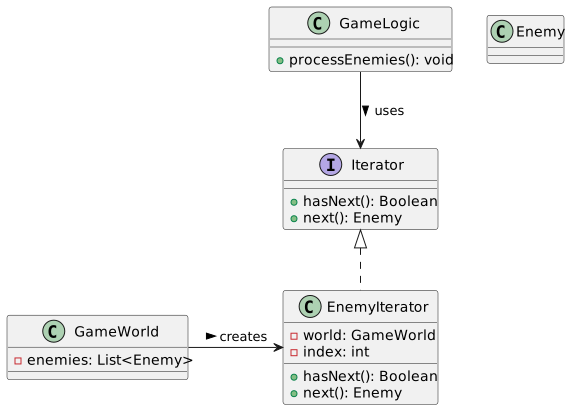
This diagram illustrates the integration of the Iterator Pattern in game logic. The GameLogic class uses an iterator to process enemies in the GameWorld.
Java Code Example: Game Logic Using Iterator
Implementing game logic using the Iterator Pattern:
public class GameLogic {
    private GameWorld world;

    public GameLogic(GameWorld world) {
        this.world = world;
    }

    public void processEnemies() {
        Iterator<Enemy> iterator = world.getEnemyIterator();
        while (iterator.hasNext()) {
            Enemy enemy = iterator.next();
            // Process each enemy
            // e.g., enemy.takeDamage(10);
        }
    }
}
This example shows how to iterate over and process game elements using an iterator.
Iterator Pattern for Infinite Collections
The Iterator Pattern can also be adapted for infinite collections:
Useful for generating infinite sequences or streams.
Allows lazy evaluation: elements are generated only when needed.
This adaptation is powerful for certain types of data processing tasks.
UML Diagram: Infinite Collection Iterator
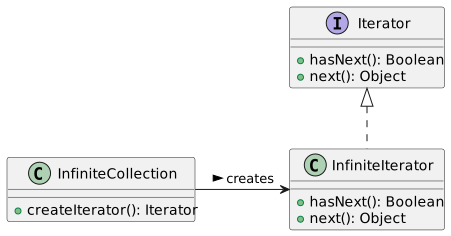
This diagram represents an InfiniteIterator for an InfiniteCollection, illustrating how iteration can continue indefinitely.
Conclusion: Benefits and Considerations of the Iterator Pattern
Benefits of the Iterator Pattern:
Separates collection data and iteration logic.
Facilitates various types of traversals and operations.
Enhances code maintainability and readability.
Considerations:
Overhead of creating iterators.
Complexity in understanding and implementing advanced iterators.
The Iterator Pattern is a versatile tool in a developer’s toolkit, applicable in many scenarios with collections.